


Summary
Overly strict workplace rules like rigid time-keeping, phone bans, and heavy internet restrictions often do more harm than good, chipping away at trust and morale instead of boosting productivity. Micromanagement, strict dress codes, and ever-growing rulebooks tend to push capable employees toward frustration or the exit. Employees given flexibility and clear expectations, rather than blanket restrictions, tend to stay more focused and get more done. A few handbook adjustments can shift how a team performs and feels.
| Time to Read | ~7 minutes |
|---|---|
| What You’ll Learn |
|
| Next Steps |
|
Workplace rules exist for good reason when they’re necessary and genuinely helpful. But rules can just as easily tip into overreach, creating distrust and lower morale instead of the order they’re meant to provide.
A healthy work environment keeps people motivated, builds loyalty, and tends to bring out better work. It can also boost output directly. When employees get freedom and flexibility, they tend to stay more focused and get more done in less time.
The data backs this up. According to MarketWatch, and based on over 100 million data points, U.S. workers were about 47% more productive in March and April of 2020, when the shift to remote work pulled them out of traditional offices, than they were over the same months in 2019.
That doesn’t mean companies should get rid of workplace rules. It means they need to be useful. A policy created because one employee abused a privilege shouldn’t necessarily become a permanent restriction for everyone else. The team at FaxBurner has compiled six common workplace rules that tend to do more harm than good.
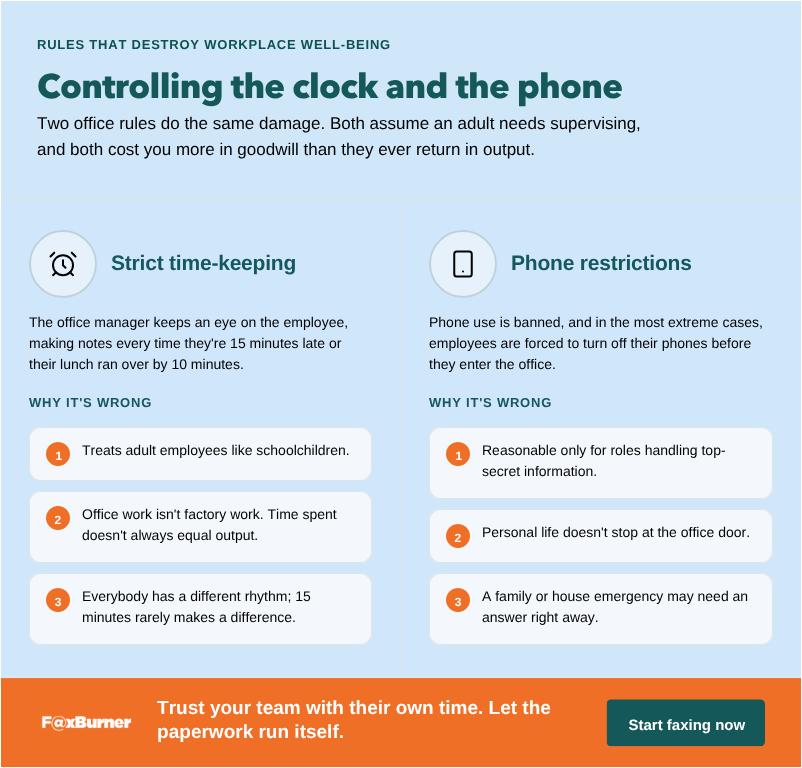
1. Strict Time-Keeping
Being on time matters. Meetings need to start, deadlines need to be met, and some jobs depend on employees being available at specific hours.
But not every job works that way.
For many knowledge workers, the amount of useful work someone gets done in an hour can vary quite a bit. A strict clock-in, clock-out approach doesn’t always tell you much about the quality of the work.
Where It Goes Too Far
- Requiring everyone to work exactly 9 to 5, regardless of their role
- Monitoring lunch and break times down to the minute
- Treating a one-time delay as a disciplinary issue
- Measuring hours at a desk instead of the work being completed
Someone might solve a difficult problem in two focused hours while another task takes three days. Both employees may still produce excellent work. The clock doesn’t tell you which one did the better job.
A Better Approach
Set clear expectations around deadlines, availability, and results. Then give employees some room to decide how they’ll get there. If the work is finished on time and meets the expected standard, the exact number of hours spent on it may not tell the whole story.
2. Phone Banning
Personal phones are a part of our everyday lives, and there’s no getting around it. Employees use them to check in with family, manage appointments, respond to urgent messages, and, yes, sometimes scroll through social media.
That doesn’t mean personal phone use should never be addressed, but a blanket ban on all phone use can create more friction than it’s worth.
Where It Goes Too Far
- Banning phones completely, including during family emergencies
- Treating a quick client message the same way as recreational scrolling
- Assuming every phone check is a productivity problem
- Creating rules that are difficult to enforce consistently
Someone who’s waiting for an important call isn’t necessarily disengaged from their work. A blanket policy leaves little room for that distinction. It can also send an unintended message: we don’t trust you to manage your own phone.
A Better Approach
Address actual performance issues when they show up, and be specific about what the issue is. Most employees self-regulate reasonably well when they’re given the trust to do so, and lose that instinct fast once they feel watched.
3. Internet Use Restrictions
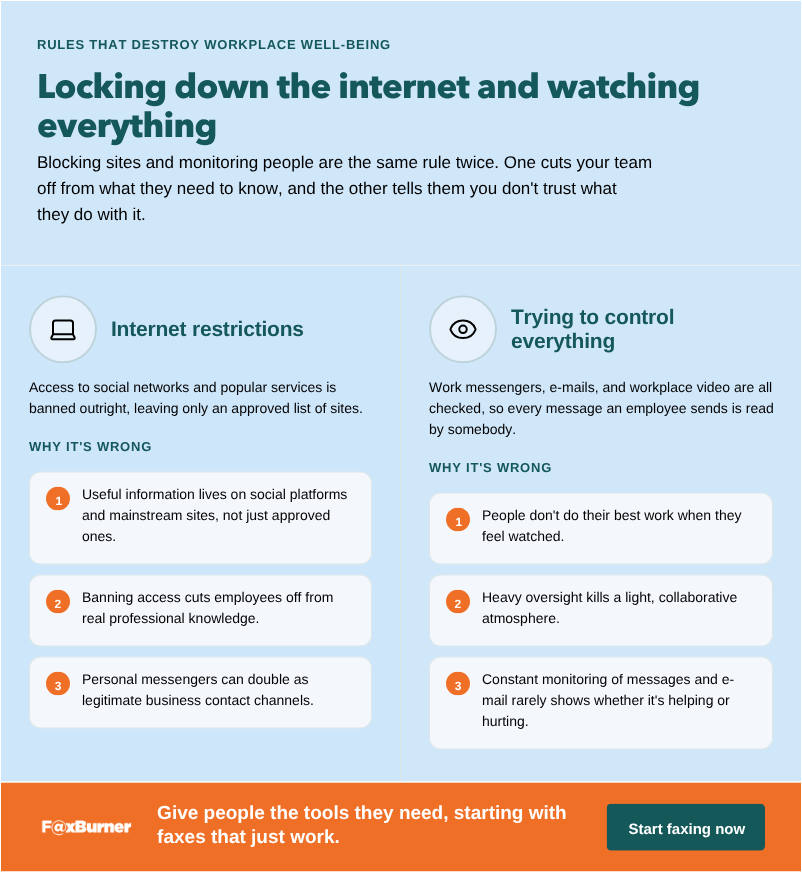
The same problem comes up with internet access. Blocking social media, news sites, or other websites can seem like an easy way to keep people focused. In practice, the line between personal and professional browsing isn’t always so neat.
An employee might need social media for work. They might take a five-minute break and come back more focused. They might also simply have a browser tab open that has nothing to do with what they’re working on.
Where It Goes Too Far:
- Blocking websites that employees may legitimately need for work
- Treating short online breaks as wasted time
- Monitoring browsing activity as a default
- Creating restrictions that employees will simply find ways around
A rule that’s easy to bypass doesn’t accomplish much. It may also create an atmosphere where employees spend more time figuring out how to work around the policy than they would have spent on the original activity.
A Better Approach
Focus on whether the work is getting done. Employees who consistently meet expectations don’t necessarily need their browser history checked. But if someone isn’t meeting the expectations you set, a conversation about performance needs to happen.
Related Reading:
4. Excessive Control (“My Way or the Highway”)
Micromanaging how and when work gets done stifles the ideas that actually move a business forward, and it tends to come from a good instinct (consistency, quality control) taken past the point where it helps.
Where It Goes Too Far:
- Requiring one exact method for every task
- Rejecting suggestions because they don’t match the existing process
- Correcting small differences that don’t affect the final result
- Creating an “us versus them” relationship between managers and employees
The people doing the work every day often notice problems that aren’t obvious from a management perspective. If employees know suggestions will be dismissed, they eventually stop making them.
That’s a loss for everyone.
A Better Approach
Keep the processes that produce better results, and be willing to revisit the rest. Employees should know what outcome is expected and which standards can’t be compromised. Within those boundaries, there’s often room to try a different method. Sometimes the person closest to the work has the best idea for improving it.
5. Dress Code and Self-Expression
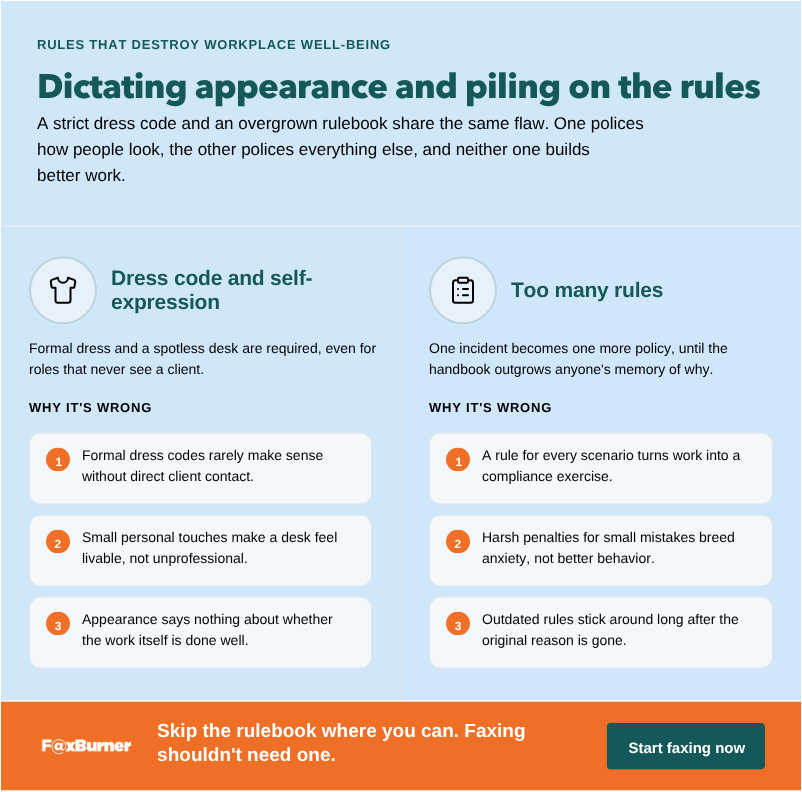
Dress codes have their place. A client-facing professional service, a construction site, and a warehouse may all have very different expectations for what employees should wear.
But a formal dress code doesn’t make much sense for every role.
Where It Goes Too Far:
- Requiring formal clothing when employees don’t interact with clients
- Restricting harmless personal items in workspaces
- Focusing on appearance when the work itself is being done well
- Treating personal expression as a distraction without a clear reason
A desk with a photo, a plant, or a favorite mug isn’t a distraction; it’s what makes eight hours in one spot feel livable. Strict personal-expression rules tend to bother capable, creative people the most, since those are often the employees least interested in conforming for its own sake.
A Better Approach
Set a reasonable standard for professionalism, safety, and client interaction. Beyond that, give employees some freedom. A workplace doesn’t have to look identical from desk to desk to be professional.
6. Too Many Rules
One rule rarely stays one rule.
An employee makes a mistake, so a new policy gets added. Something else goes wrong six months later, and another rule follows. Before long, the employee handbook is full of policies that nobody remembers creating.
Even reasonable rules can become a problem when there are too many of them.
Where It Goes Too Far:
- Creating a policy for every possible situation
- Making employees worry more about breaking rules than doing their jobs
- Using harsh penalties for minor mistakes
- Keeping outdated policies simply because they’ve always been there
Rulebooks tend to grow one incident at a time and rarely shrink. Nobody schedules time to ask whether last year’s fix is still needed, so the list just gets longer, and longer lists get skimmed rather than read, which defeats the point of having them at all.
A Better Approach
Keep the rulebook manageable. For every policy, ask what problem it solves. If there’s no clear answer, it’s worth asking whether the rule still belongs there. The same goes for old policies. If nobody can remember why a rule was introduced, and the original problem no longer exists, it may be time to retire it.
Building a Healthier Rulebook
Every company needs some ground rules. The trick is knowing which ones actually help and which just exist for the sake of having them.
Over-regulating a team tends to backfire. Stressed, distrustful employees produce lower-quality work and leave sooner, especially when they’ve never given a reason to be distrusted in the first place. And once a workplace earns a reputation for micromanaging, it tends to attract fewer of the self-directed people it was probably trying to protect against slacking in the first place.
A good starting point is a simple audit. Pull up the employee handbook and, for each rule, ask what specific problem it was written to solve and whether that problem is still around. Keep rules that trace back to a real, current issue, and cut rules that only exist because “that’s how it’s always been.”
A good workplace doesn’t need a rule for everything. It needs clear expectations, sensible boundaries, and enough trust for employees to do their jobs well.
